
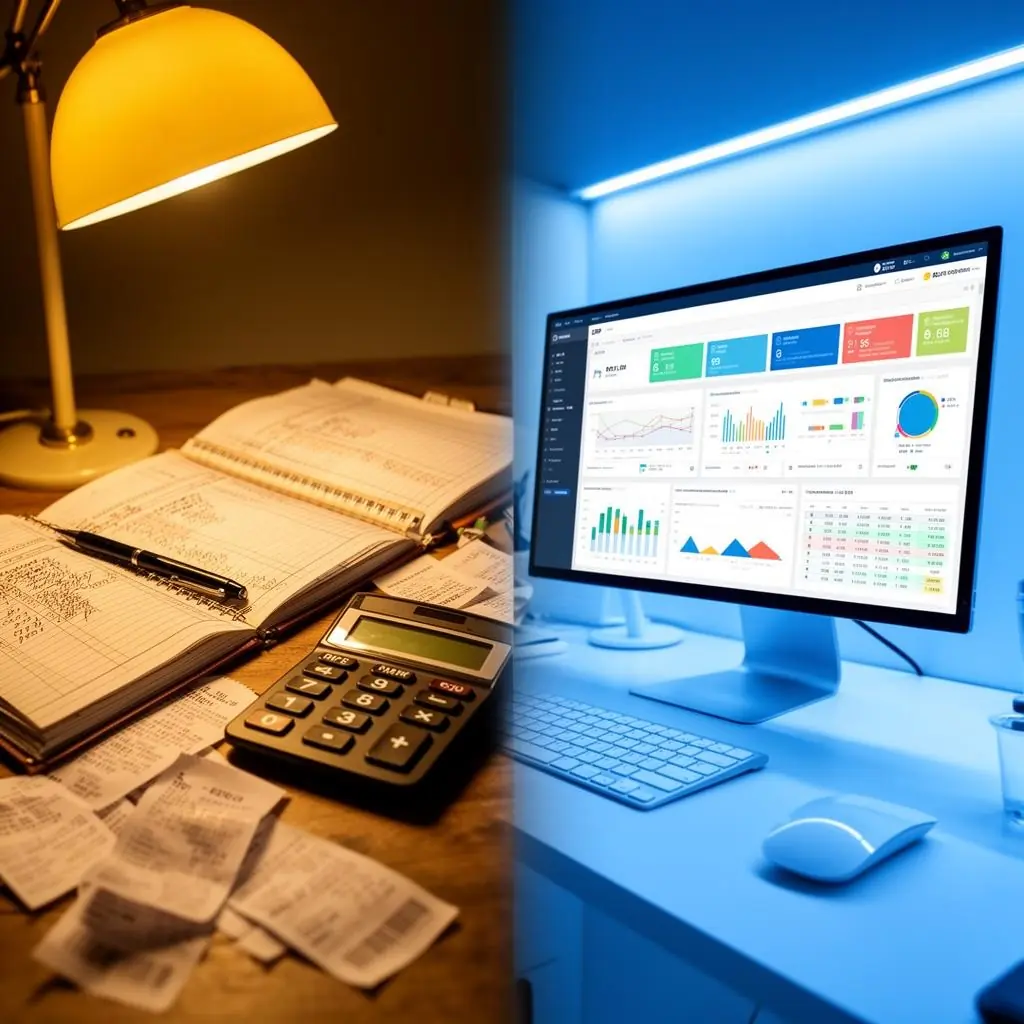

From Ledger to Cloud: Why the History Matters
An accountant posting entries today in a cloud system connected to ZATCA relies on the same principle a Venetian merchant used more than five centuries ago: every entry has two sides, debit and credit, and they balance. The logic of accounting has barely changed. The tools carrying it have changed completely, and with them the speed, the accuracy and the gap between a transaction happening and showing up in a report.
This is not nostalgia. Plenty of Saudi businesses still run on tools from earlier stages: handwritten books in small shops, Excel workbooks carrying the entire finance function in mid-sized firms, and standalone accounting packages that cannot see sales or inventory. Knowing which stage your company is in, and what staying there costs, is the first step in deciding whether to move.
This guide walks through the stages of accounting systems, compares them in practical terms, explains what cloud ERP actually does for the finance team, sets out the Saudi requirements that made the move unavoidable for many, and closes with a realistic migration plan.
Stage One: Manual Books
In 1494 the Italian friar and mathematician Luca Pacioli published his treatise on arithmetic and geometry, including a description of the double-entry method Venetian merchants were using. For most of the centuries that followed, accounting meant a handwritten journal, postings to a ledger, and a trial balance prepared by hand at period end.
It produced careful accountants, because mistakes were expensive. It also had obvious limits: monthly accounts took weeks, an unbalanced trial balance could mean hours searching for one transposed figure, analysis by branch or product meant re-adding everything by hand, and a fire or a leak could erase the company's financial history.
In Saudi Arabia, the Commercial Books Law of 1409H required merchants to keep books including a journal and an inventory book and to retain them for ten years. On 27 October 2026 the Council of Ministers approved a new Commercial Transactions Law that replaces the Commercial Law, the Commercial Papers Law and the Commercial Books Law, effective 180 days after publication in the Official Gazette. Bookkeeping and retention requirements are therefore worth reviewing with your adviser once the detail is published.
Stage Two: Spreadsheets
VisiCalc arrived on the Apple II in 1979 as the first spreadsheet for personal computers, followed by Lotus 1-2-3 in 1983 and then Excel, which became the default tool in finance departments everywhere. For the first time you could change one number and watch every dependent figure update.
Spreadsheets are excellent for analysis, models and budgets. Used as the accounting system, they fail in predictable ways. There is no audit trail, so nobody knows who changed a figure or when. There are no permissions, so anyone with the file can edit any cell. Version chaos sets in ("Final v3 revised" against "Final v3 revised LATEST"). A single mis-dragged formula breaks a report silently. And invoices, stock and payroll still have to be keyed in by hand.
Stage Three: Standalone Accounting Software
Desktop accounting packages fixed a lot: a structured chart of accounts, entries that must balance, invoices and vouchers, standard financial reports and user rights. It was a big step, but each package remained an island. Sales lived in one system, stock in a spreadsheet, payroll in another program, and the accountant received summaries from each and keyed them in. The software usually ran on an in-house server that needed maintenance, backups and upgrades and was awkward to reach from outside the office.
The signs that a company is stuck here are easy to spot. Finance receives a weekly sales file from branches and re-enters it. Inventory in the accounting package only matches the warehouse after a manual month-end adjustment. Branch profitability is built in Excel from an export. Remote access means a VPN to the server. If three of those sound familiar, the hours your team spends bridging systems are now a measurable cost.
Stage Four: Cloud ERP
In an ERP, accounting is not a department that receives data. It is the automatic consequence of every operation. A sales invoice creates the revenue, VAT and receivable entries, relieves inventory and records cost of sales. A goods receipt updates stock and payables. A payroll run posts salaries and GOSI. The accountant shifts from data entry to review and analysis. The cloud adds the rest: no servers to run, automatic updates, secure access from anywhere, and a predictable subscription instead of a large capital outlay.
The Stages Side by Side
| Aspect | Manual | Spreadsheet | Standalone software | Cloud ERP |
|---|---|---|---|---|
| Balanced entries | Depends on the accountant | Depends on formulas | Enforced | Enforced |
| Audit trail | Paper signatures | None | Yes | Full, per change |
| Link to sales and stock | No | Manual | Limited or manual | Automatic |
| E-invoicing | Not possible | Not possible | Needs add-ons | Built in |
| Reporting by branch or project | Manual re-adding | Possible with effort | Limited | Dimensions on every entry |
| Infrastructure | Books and archive | A PC | In-house server | Run by the provider |
Why Saudi Businesses Had to Move
E-invoicing
Phase 1 (generation) started on 4 December 2021 and Phase 2 (integration) has rolled out in waves since 1 January 2023. Wave 24 covers taxpayers with turnover above SAR 375,000, and Wave 25 covers those above SAR 187,500 in any year from 2022 to 2025, with compliance due from 1 February 2027. In Phase 2, standard tax invoices are cleared by ZATCA in real time before they reach the buyer, and simplified invoices are reported within 24 hours. A notebook or a spreadsheet cannot do that. Our Saudi e-invoicing guide has the detail.
IFRS
Saudi entities report under IFRS as endorsed by SOCPA: listed companies since 2017 and other entities since 2018, with IFRS for SMEs available. IFRS 18 replaces IAS 1 for periods beginning on or after 1 January 2027, changing the income statement with a new operating profit subtotal among other things. A system that lets you re-map accounts and dimensions makes that change far less painful.
Deadlines
- VAT returns are monthly above SAR 40 million of annual taxable supplies, otherwise quarterly, due by the end of the following month.
- Zakat and corporate income tax returns are due within 120 days of year end.
- Financial statements must be filed on the Ministry of Commerce Qawaem platform within six months of year end.
- VAT records must be kept for at least six years, eleven years for certain capital assets and fifteen for real estate.
Every one of these needs closed, reconciled numbers on time, and a slow manual close squeezes all of them.
What Cloud ERP Does for Finance in Practice
A lean chart of accounts with dimensions
Instead of a separate account for every branch and project, keep the chart simple and tag each entry with branch, department, project and cost center. Branch or project profitability becomes a standard report rather than a weekend in Excel.
Entries generated by operations
Take a SAR 10,000 sale before VAT of goods costing SAR 7,000. Without anyone touching a journal, the system posts: debit receivables 11,500, credit sales 10,000 and VAT payable 1,500; debit cost of sales 7,000, credit inventory 7,000. In a standalone setup, that was two entries in two programs and a reconciliation later.
Bank reconciliation
Statements are imported and matched to recorded receipts and payments by amount, date and reference. The accountant handles only exceptions: an unrecorded bank charge, a customer transfer with no clear reference.
Receivables and payables
Aging by bucket (up to 30 days, 31 to 60, 61 to 90, over 90), each receipt matched to its invoices, and alerts on due items. A hypothetical ledger with SAR 2.4 million of receivables, SAR 600,000 of it over 90 days, deserves a weekly meeting with sales on that number alone.
Fixed assets, close and controls
Each asset has a record, with depreciation calculated and posted automatically and disposals, revaluations and gains or losses handled in the same place. Month-end runs from an ordered checklist, recurring entries such as depreciation, accruals and deferred revenue post automatically, and periods are locked once approved. Segregation of duties separates whoever creates a payment from whoever approves it, approval limits scale with amount, and a complete change log shows the auditor who did what and when.
Month-End Close Before and After
A hypothetical services company with three branches:
| Task | Before (spreadsheets plus standalone package) | After (cloud ERP) |
|---|---|---|
| Collect branch invoices | Two days to receive files and key them in | Not needed; invoices are issued in the system |
| Reconcile three bank accounts | Two days | Half a day on exceptions |
| Payroll and GOSI entries | One day re-entering the payroll | Posted automatically from payroll |
| Depreciation and accruals | One day in Excel | Recurring entries reviewed in an hour |
| Statements and branch reports | Two days compiling and formatting | Ready from dimensions |
The figures are illustrative. The point is that time once spent moving and compiling numbers goes into asking why branch two's costs rose and why the largest customer is paying late.
How the Accountant's Job Changes
The fear is that automation reduces the need for accountants. In most companies what disappears is keying, copying and compiling; the need for professional judgment grows. In an ERP the accountant spends time on exceptions (unmatched items, invoices rejected by the ZATCA platform, stock differences), on configuration (mapping transaction types to accounts, tax rules per item and customer, cost centers, where one error repeats across thousands of entries), on analysis (margins, aging, cash forecasts, budget variances) and on compliance (tax and zakat returns, IFRS disclosures, the external audit). Migration plans should include developing the finance team's skills, not just teaching them new screens.
KPIs to Judge the Move
| KPI | How to measure | What it shows |
|---|---|---|
| Days to close | Month end to approved statements | Efficiency of the whole finance process |
| Manual journal share | Manual entries ÷ all entries | How much you rely on automated posting |
| Post-close adjustments | Changes to closed periods | Data quality at source |
| DSO | Receivables ÷ credit sales × days in period | Speed of turning sales into cash |
| Rejected e-invoices | Invoices rejected by ZATCA ÷ total | Quality of customer and item data |
Record these before the move and compare at three and six months. Without a baseline, the evaluation becomes a matter of impressions.
Common Concerns About the Cloud
Security
The useful question is not "is the cloud safe?" but "what controls does this provider have?" The National Cybersecurity Authority has issued Cloud Cybersecurity Controls (CCC-2:2024), and the Cloud Computing Regulatory Framework keeps government data inside the Kingdom. The Personal Data Protection Law has been in force since September 2023, with enforcement after a one-year grace period, and sets conditions for transfers abroad. Ask about hosting location, encryption, backups, access rights and login logs. Google Cloud opened its Dammam region in November 2023, widening local hosting options. See our article on cybersecurity and the PDPL.
Connectivity and control
Most city offices have stable connections, and a backup line reduces the risk further. The right comparison is not with a system that never goes down, but with an in-house server that also fails, except that fixing it is your job. On control, make sure the contract guarantees your right to export all your data in a usable format at any time, backed by a clear service level agreement.
A Realistic Migration Plan
- Pick the start date carefully. The start of a financial year or quarter is easiest because opening balances are already reviewed.
- Clean the chart of accounts. Remove duplicates and dormant accounts and turn per-branch accounts into dimensions.
- Migrate balances, not all history. Opening balances, open receivables and payables with their invoices, inventory and assets. Detailed history stays in the old system for reference, within statutory retention periods.
- Onboard and test e-invoicing through ZATCA's compliance checks before go-live.
- Run one month in parallel and compare trial balance, receivables and inventory before switching off the old system.
- Train by role. An accountant needs different training from a salesperson who issues invoices.
For more, see our guide to cloud ERP migration in Saudi Arabia.
How Tranquil Helps
Tranquil is a cloud ERP with accounting and finance and ZATCA e-invoicing for Phase 1 and Phase 2, with real-time integration and automatic validation, alongside inventory, sales, purchasing, HR, payroll and asset management. Certified training is available on-site or remotely, with 30 days of post-training support. For the features to look for in any system, read our article on accounting software features.
Frequently Asked Questions
Is Excel enough for a small business?
It is fine for analysis and budgets, but not as the core accounting system: no audit trail, no permissions, no e-invoicing. Businesses covered by an integration wave need a compliant system regardless.
What is the difference between accounting software and ERP?
Accounting software records entries and produces financial reports. ERP connects accounting to sales, purchasing, inventory, payroll and assets, so entries are generated by the operations themselves.
Is my data safe in the cloud?
That depends on the provider's controls. Ask about hosting location, encryption, backups, access rights and data export, and check alignment with NCA controls and the PDPL.
How long does a move to cloud ERP take?
It depends on size, number of branches and data quality. A single-site small business can move in weeks; multi-branch companies usually need months, including a parallel month.
Is Tranquil e-invoicing compliant?
Yes. Tranquil issues invoices compliant with Phase 1 and Phase 2 with real-time ZATCA integration. Contact the Tranquil team for a quote within 24 hours.