
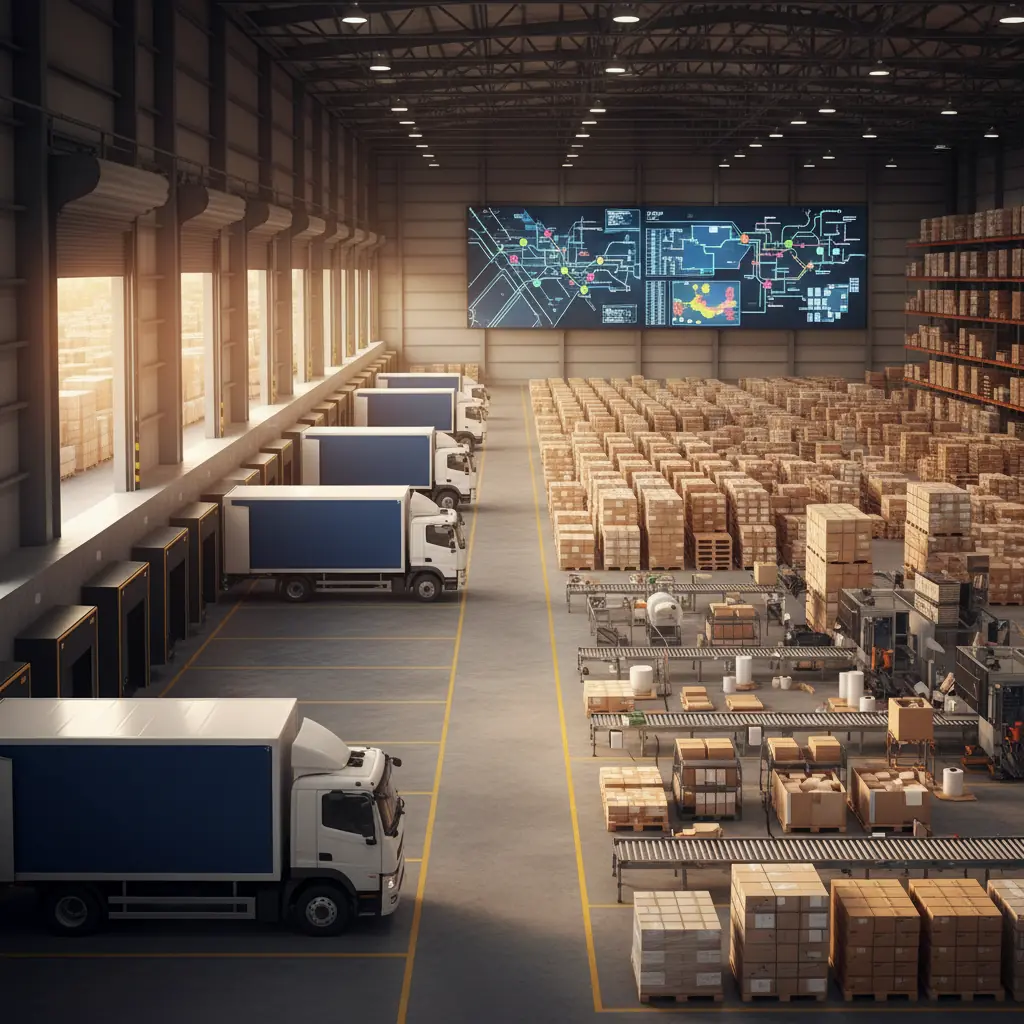

What distribution management covers
Distribution management is everything that happens to a product between the moment it is ready to sell and the moment the customer has it: where it is stored, how stock is split across warehouses and branches, how orders are received and picked, who delivers them and in what sequence, how returns are handled and how the sale is invoiced and collected. It is the link that turns a good product into actual revenue, and every weakness in it shows up in customer satisfaction and gross margin.
A company with a competitive product at a fair price can still lose ground because its truck reaches the grocery on Thursday instead of Tuesday, because orders arrive two lines short every time, or because the salesperson cannot see warehouse stock before promising a date. A company that runs distribution well can sell more from the same inventory and serve more distant regions without its costs doubling.
This guide explains why distribution matters, what it is made of, how the Saudi market shapes it, what a route planning exercise looks like in numbers, which metrics to track and where an ERP system fits.
Why distribution management matters
It is a large slice of cost
Storage, transport, handling and returns can make up a meaningful share of the cost of a delivered product, especially for low-price, high-volume goods such as food and building materials. These costs leak quietly: a truck that leaves half full, a sales visit to a customer who never orders, an order picked twice because the first pick was wrong. Every riyal saved in distribution goes straight to profit.
It is what the customer actually sees
Customers never see your production planning or your purchasing discipline. They see whether the order arrived on time, whether it was complete and whether the invoice was right. In retail supply, foodservice and pharmacy distribution, delivery reliability is often the deciding factor between keeping and losing an account.
It determines how much stock you need
When distribution is unreliable, each branch compensates by ordering more than it needs. The result is surplus in one location and stockouts in another for the same item. Well-run distribution supports lower total inventory with higher availability.
It drives cash flow
Order, delivery, invoice and collection form one chain. A late proof of delivery delays the invoice, and a late invoice delays collection. Many companies discover that their long collection days are caused by delivery notes that drivers bring back late, not by customers who pay late.
It is the precondition for growth
Entering a new region or channel depends on the network serving it at a reasonable cost. Without numbers on the cost to serve each area, expansion becomes guesswork.
The building blocks
| Component | What it includes | The question it answers |
|---|---|---|
| Network design | Number and location of warehouses, branches, cross-dock points | Where do we serve each region from? |
| Inventory allocation | Splitting stock across locations | How much sits where? |
| Order management | Capture, reservation, pricing, credit approval | Can we fulfill this order, and when? |
| Warehouse fulfillment | Picking, packing, loading | How do we prepare it fast and accurately? |
| Transport and delivery | Fleet, routes, carriers | Who delivers, in what order? |
| Proof of delivery and invoicing | Customer signature, e-invoice | When does the order become a receivable? |
| Returns | Receipt, inspection, restock or write-off | What happens to what comes back? |
These pieces depend on each other. Excellent route planning is wasted if orders reach the warehouse late, and fast picking is wasted if the branch allocation was too small. Good distribution management looks at the whole chain, not one link.
Channels shape the operation
- Modern trade: hypermarkets and chains. Large orders, fixed receiving slots at their distribution centers, strict labeling and documentation, and sometimes penalties for late or short deliveries.
- Traditional trade: groceries and small shops. Small, frequent orders, regular salesperson visits and often van sales with cash or short credit.
- Foodservice: deliveries in tight windows before opening hours, sometimes temperature controlled.
- Projects and contractors: bulk loads to changing sites, tied to construction schedules.
- E-commerce: many single orders, high expectations on speed and tracking, and higher return rates.
A business serving several channels needs different rules for priority, allocation and credit in each. Otherwise its most profitable channel ends up queuing behind less important orders.
What makes distribution in Saudi Arabia different
Distance
Major cities are far apart. Riyadh to Dammam is roughly 400 km by road, and Riyadh to Jeddah roughly 950 km. That makes the number and location of warehouses a significant financial decision. An extra warehouse in the Western Region adds rent and inventory, but it removes days from delivery times and cuts transport cost per order.
Van sales
Selling from the truck is common in food, beverages and household products. The salesperson carries stock, sells, invoices and collects on the spot. Each van is effectively a mobile warehouse that needs a daily count and settlement, and every invoice it issues must be a compliant e-invoice. ZATCA's Phase 1 (generation) began on 4 December 2021, and Phase 2 (integration with Fatoorah) has rolled out in waves since 1 January 2023, reaching businesses with turnover above SAR 375,000.
Seasonality
Ramadan, Eid, back-to-school and the Hajj and Umrah seasons shift both volume and mix in many sectors. A network that copes in ordinary months can buckle in the weeks before Ramadan if stock and fleet were not planned ahead.
VAT on every drop
VAT has been 15% since July 2020 and appears on every distribution invoice. Pricing errors on vans or in customer-specific deals produce wrong invoices that are awkward to correct once issued, which is why prices should come from the system rather than the salesperson's memory.
Worked example: what route planning is worth
Hypothetical example: a Riyadh food distributor runs 8 trucks serving 320 traditional-trade customers. Before planning, each driver picked his own route and visit days followed habit rather than geography.
| Metric | Before | After |
|---|---|---|
| Average km per truck per day | 180 | 135 |
| Average stops per truck per day | 22 | 27 |
| Daily cost per truck (driver, fuel, maintenance) | SAR 950 | SAR 880 |
| Cost per stop | SAR 43.2 | SAR 32.6 |
Grouping customers into fixed zones for each weekday cut mileage and allowed more stops per day. Cost per stop fell by about 25%. The same eight trucks can now take on new customers without extra cost, or the existing customer base can be served with fewer vehicles.
Just as important, decisions now rest on data. Once cost to serve is known per customer, it becomes clear which accounts do not cover the cost of visiting them, and minimum order values or visit frequency can be reviewed accordingly.
Own fleet or third-party carriers?
| Criterion | Own fleet | Third-party carriers |
|---|---|---|
| Control over timing and customer experience | High | Moderate, depends on contract |
| Fixed cost | High: vehicles, insurance, maintenance, salaries | Low, pay per shipment |
| Seasonal flexibility | Limited by fleet size | Higher, can scale temporarily |
| Selling and collecting from the vehicle | Possible | Usually not suitable |
| Best for | Fixed daily routes and van sales | Distant regions and irregular bulk loads |
Many distributors mix both: their own fleet for the home city and daily selling routes, carriers for replenishing distant branches or covering the Ramadan peak. What matters is knowing the cost of each option per region.
Allocating stock when there is not enough
When supply falls short of demand, who gets served first? Sound allocation rests on actual demand per location (recent sales, not what the branch manager asks for), the replenishment cycle (a branch visited weekly needs longer cover than one served daily) and priority rules (key account contracts, more profitable channels, confirmed orders before forecasts).
Hypothetical example: 1,000 cartons of a fast-moving item arrive, and branch requests total 1,400. First-come allocation gives the earliest requester everything. Proportional allocation gives each branch about 71% of its request. Priority allocation first covers chain contracts that carry late-delivery penalties, then splits the remainder proportionally. None is right every time, but the rule should be written down and enforced in the system, not decided by whoever phones the warehouse first. Our guide to inventory allocation goes deeper.
Returns: the forgotten loop
- Record the return on receipt against the original invoice, with a reason code: damage, wrong item, expiry, customer refusal.
- Inspect and grade: resaleable, needs repacking, or scrap.
- Put resaleable stock back into available balance immediately rather than leaving it in a corner.
- Issue a credit note, which is also subject to e-invoicing requirements.
- Analyze causes monthly. If 40% of returns stem from picking errors, the problem is in the warehouse, not with the customer.
Metrics that matter
- On time in full (OTIF): share of orders delivered on the agreed date with complete quantities. The closest proxy for customer experience.
- Fill rate: quantity delivered against quantity ordered, by line or unit.
- Cost per order or per stop: exposes high-cost regions and customers.
- Picking accuracy: orders prepared without item or quantity errors.
- Return rate by reason.
- Order-to-delivery and delivery-to-invoice time.
- Vehicle fill: by weight or volume, a direct measure of loading efficiency.
Start with three you will genuinely review every week. OTIF, cost per stop and return rate are a solid starting set for most distributors.
A 90-day improvement plan
- Month one, measure: OTIF, cost per stop and return rate by region. This is your baseline.
- Month two, quick fixes: fixed visit days per zone, same-day link between proof of delivery and invoice, daily van stock settlement.
- Month three, structural decisions: review customers whose cost to serve exceeds their margin, allocation rules, and whether another warehouse or cross-dock point is justified.
After 90 days you will have numbers to compare against the baseline, which is the only reliable way to know whether the changes worked. Keep the baseline report and repeat the same measurements every quarter so that improvements, and any slippage during peak seasons, are visible to management rather than anecdotal.
Common mistakes
- Accepting orders before checking stock, so the salesperson promises what does not exist.
- Allocating purely first-come, first-served, with no priority for key accounts or channels.
- Paper delivery notes that return late and hold up invoicing.
- Skipping daily van settlement, so variances pile up and become unexplainable.
- Handling returns outside the system, leaving returned stock in limbo.
- Tracking transport cost only in total, without cost to serve by region or customer.
Where ERP fits
An integrated system connects links that are usually separate. Sales sees available stock when entering the order, the warehouse sees approved orders and picks them, delivery is confirmed and triggers the e-invoice, the invoice becomes a receivable, and a return flows back into stock with the right entries. Each step builds on the previous one without rekeying.
Tranquil's sales and distribution module covers quotations, invoices, deliveries, returns and customers, and works with multi-location inventory management, central inventory and ZATCA-compliant e-invoicing for Phase 1 and Phase 2. See how this applies to distributors on our distribution industry page, and read our article on ERP for distribution and logistics for the logistics side.
Frequently Asked Questions
How is distribution management different from supply chain management?
Supply chain management covers the full journey from raw material purchasing to the end customer, including procurement and production. Distribution management is the part that starts once a product is ready to sell: storage, allocation, fulfillment, transport, delivery and returns.
Which single metric best reflects distribution performance?
On time in full is closest to the customer's experience, but pair it with a cost metric such as cost per stop. Otherwise high service levels can be bought at a cost the business cannot sustain.
Do van sales invoices need to be e-invoices?
Yes. Invoices issued from vans are tax invoices like any other and fall under ZATCA's e-invoicing requirements, including Fatoorah integration for businesses covered by Phase 2 waves.
When does a second regional warehouse make sense?
When the cost of serving a region from your current warehouse, in freight, time and lost orders, exceeds the cost of running a local site with its rent, stock and staff. That calculation needs real cost-to-serve data by region.
Is Tranquil suitable for distribution companies?
Tranquil combines sales and distribution, inventory, purchasing, accounting and e-invoicing in one cloud system. You can contact the Tranquil team to discuss your distribution network.