
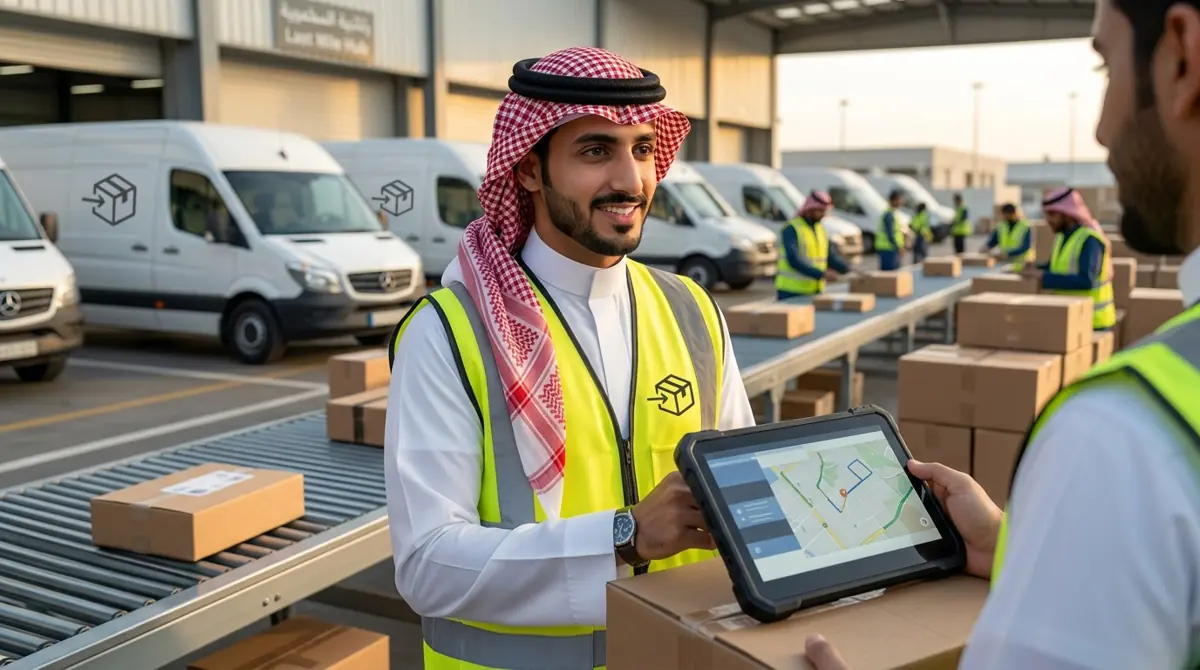

Why the Last Mile Decides the Customer Experience
The last mile is the final leg of delivery, from your warehouse, branch or distribution centre to the customer's door, shop or site. It is the shortest part of the journey in distance, yet it is usually the most expensive per unit and the part customers remember. A shipment can cross an ocean on schedule and still be judged a failure if the van arrives at the wrong building or after the shop has closed.
In Saudi Arabia the last mile carries its own challenges: long distances between cities, fast-growing suburbs, summer heat that affects both drivers and goods, and customers who expect to track their order on their phone. The National Transport and Logistics Strategy, launched in June 2021, aims to raise the sector's share of GDP from 6% to 10%, which tells you how much attention logistics is getting nationally.
This guide covers how last-mile delivery and a distribution fleet can be organised around an ERP system: what data the ERP should hold, which processes it should control, how to cost each delivery, and where specialised routing or tracking tools fit. We avoid unsourced industry percentages. The figures in the examples are hypothetical and labelled as such.
What Makes the Saudi Last Mile Different
| Challenge | What it causes | Practical response |
|---|---|---|
| Long distances and spread-out cities | High fuel and driver time per drop | Zone-based delivery days, route planning, minimum order values per zone |
| Incomplete or informal addresses | Failed first attempts and repeat trips | Capture the National Address short code at order entry |
| Heat and sensitive goods | Spoilage of food, medicines and some chemicals | Temperature-controlled vehicles, loading rules, temperature records |
| Customer expectations for updates | Calls to customer service, missed deliveries | Delivery windows and status notifications linked to the order |
| Cash and paper on delivery | Reconciliation gaps and disputes | Digital proof of delivery, cash collection recorded against invoices |
The Address Problem and the National Address
Failed deliveries often start with a vague address: a district name and a landmark, or a pin dropped approximately on a map. Saudi Arabia has a structured alternative. The National Address system, devised by Saudi Post (SPL) and launched in 2013, gives each building a four-digit building number, a street, a district, a five-digit postal code and a four-digit additional number. It also offers a short address made of four letters and four digits, which is accurate to roughly one to two metres.
The practical step is simple and often skipped: make the National Address or short address a required field on the customer record and on delivery orders. For B2B customers, it should already appear in their registration documents. For B2C orders, ask for it at checkout. Every failed first attempt you avoid saves a second trip, extra fuel and an unhappy customer.
Core Last-Mile Processes the ERP Should Control
1. Order to dispatch
Delivery planning starts with clean orders. Each sales order should carry the delivery address, requested date or time window, special handling notes and the items with weights or volumes. When the order is confirmed, the ERP reserves stock in the right warehouse so the picker is not sent for goods that have already been promised to someone else.
2. Picking, packing and the delivery note
The warehouse picks against the order and the system issues a delivery note listing exactly what left the building. That document is the reference for everything after: proof of delivery, invoicing and any return.
3. Load and route planning
Orders are grouped into trips by zone, vehicle type and time window. Two rules make a large difference. Load in reverse delivery sequence so the first drop is nearest the door, and keep chilled or frozen goods separate from ambient goods. Whether you plan routes manually, in a dedicated routing tool, or through an integration, the trip should be linked back to the delivery notes it contains.
4. Proof of delivery
A signature on paper that returns to the office days later is a weak control. Electronic proof of delivery, with the recipient's name, time, location and a photo where useful, closes disputes quickly and allows invoicing to move as soon as goods are received. Partial deliveries and refusals should be recorded against the specific lines of the delivery note.
5. Invoicing and cash collection
For B2C sales, simplified tax invoices under ZATCA Phase 2 must be reported to ZATCA within 24 hours of issue, so the invoicing step cannot wait for paperwork to return from drivers. Where drivers collect cash or card payments, the receipt should be recorded against the invoice in the ERP the same day, and each driver's collections reconciled at the end of the shift.
6. Returns and reverse logistics
Returns are part of the last mile. A customer refuses damaged goods, a shop sends back near-expiry stock, or an online buyer cancels. Under the Saudi E-Commerce Law, consumers may generally cancel within seven days of receiving goods if they have not used them, with exceptions such as customised items, and may cancel if delivery is delayed more than fifteen days past the agreed date. Your process should record the return against the original invoice, issue a credit note where needed, inspect the goods and put them back into stock or into a quarantine location.
Cold Chain Deliveries
For food distributors, last-mile temperature control is a regulatory matter, not just a quality preference. The SFDA's general requirements for food transport set chilled temperature ranges of 1.5 to 10°C depending on product, with chilled dairy and meat at a maximum of 5°C, and frozen goods at -18°C or below. They require continuous recording of vehicle temperature, a thermometer readable from outside, clean insulated vehicles, and separation of different food types.
In practice that means:
- Assigning refrigerated orders only to vehicles flagged as refrigerated in the fleet register.
- Keeping temperature logs for each trip and linking them to the delivery notes, so you can answer a customer or inspector's question about a specific batch.
- Limiting door openings by planning drop sequences carefully, especially in summer.
- Recording batch and expiry dates on delivery notes so a recall can be traced to the customer level.
Our article on cold chain management in Saudi Arabia goes deeper into this topic.
Costing Each Delivery
Many distributors know their total transport bill but not what a single delivery to a single customer costs. Without that figure, it is impossible to set sensible minimum order values, delivery fees or zone schedules. A practical cost model includes:
- Vehicle cost: depreciation or lease, insurance, registration and maintenance, spread over working days.
- Fuel: per kilometre, by vehicle type.
- Driver and helper cost: wages, allowances, GOSI where applicable, overtime and accommodation.
- Handling and packaging: including cool boxes or ice packs for sensitive goods.
- Failed attempts and returns: the cost of trips that did not result in a completed delivery.
A hypothetical example
A distributor runs a refrigerated van with a daily cost of SAR 1,150 (vehicle SAR 320, fuel SAR 260, driver and helper SAR 520, other SAR 50). On a route serving 22 shops it makes 20 successful drops, so the cost per successful drop is about SAR 57.50. On another route the same van completes only 11 drops because the stops are far apart, raising the cost to about SAR 104.50 per drop. If the average order on that second route is worth SAR 900 at a 12% gross margin, the margin per order is SAR 108, leaving almost nothing after delivery. The options become clear: deliver to that zone twice a week instead of daily, set a higher minimum order, or charge a delivery fee.
Own Fleet, Third-Party Carrier or Both?
Not every company should run its own vans. The right model depends on order volume, geography, product sensitivity and how much control you need over the customer experience.
| Model | Suits | Advantages | Watch out for |
|---|---|---|---|
| Own fleet | Dense, regular routes; B2B distribution to shops; sensitive goods | Control of service, branding, cash collection and temperature | Fixed costs when volume drops; driver management; vehicle maintenance |
| Third-party carrier | Scattered B2C orders; new regions; seasonal peaks | Variable cost per parcel; wide coverage without investment | Less control over timing; integration of status updates; claims for damage |
| Hybrid | Core cities by own fleet, remote areas by carrier | Balances cost and control | Two processes to manage; consistent customer communication |
Whichever model you choose, the ERP should treat a carrier shipment like any other delivery: linked to the order and delivery note, with the carrier's tracking reference, delivery confirmation and charges recorded. Carrier invoices can then be matched to the shipments they cover, and the delivery cost per order compared across your own fleet and each carrier.
A quick break-even check
Using the hypothetical van above at SAR 1,150 per day, and a carrier quoting SAR 35 per drop for the same zone, the van is cheaper only if it completes more than about 33 drops a day (1,150 divided by 35). If your routes in that zone average 20 drops, the carrier is cheaper on cost alone, and the decision then rests on service control, cash collection and temperature requirements.
Measures Worth Tracking
| Measure | How it is calculated | Why it matters |
|---|---|---|
| First-attempt delivery rate | Deliveries completed on first visit divided by total attempted | Every failure adds a trip and a customer contact |
| On-time in full | Orders delivered complete within the promised window divided by total orders | Main measure of service reliability |
| Cost per drop | Total trip cost divided by successful drops | Basis for zone schedules and delivery fees |
| Vehicle fill rate | Loaded weight or volume divided by vehicle capacity | Low fill means paying for empty space |
| Return rate | Returned value divided by delivered value | Signals picking, damage or ordering problems |
| Proof of delivery lag | Time from delivery to POD recorded in system | Long lags delay invoicing and disputes |
ERP and Specialised Delivery Tools
Route optimisation engines, GPS telematics and driver mobile apps are specialised tools. Some companies use them directly, others through a logistics provider. The ERP's job is different: it is the system of record for orders, stock, delivery notes, invoices, returns and costs. The best results come when the two are connected, so that orders flow out to the routing tool and delivery status, proof of delivery and collected payments flow back into the ERP against the right documents. Without that link, staff end up re-keying data and reconciling two versions of the truth.
Common Mistakes
- Accepting orders without a structured address, then blaming drivers for failed deliveries.
- Invoicing only when paper delivery notes return to the office.
- Mixing chilled and ambient goods on the same trip without separation or temperature records.
- Treating all zones the same, regardless of their real cost per drop.
- Recording returns as new stock receipts instead of linking them to the original sale.
How Tranquil ERP Fits
Tranquil's sales and distribution module covers quotations, invoices, deliveries, returns and customer records, and its inventory, financial accounting and ZATCA e-invoicing modules share the same data. That means a delivery, its invoice, any return and the related credit note stay linked. Asset management can hold the fleet register, with each vehicle's custodian, location and automatic depreciation. Where a routing or tracking tool is needed, Tranquil's customisation services include API integrations. See the order management and warehouse management pages, and our guide to distribution logistics for the wider picture. To talk through your delivery operation, contact the Tranquil team.
Frequently Asked Questions
What is last-mile delivery?
It is the final stage of delivery, from your warehouse or branch to the customer's location. It is usually the most expensive stage per unit because each vehicle makes many small drops rather than one large one.
How does the National Address help deliveries?
It gives each building a structured address with a building number, street, district, postal code and additional number, plus a short address of four letters and four digits accurate to about one to two metres. Recording it on customer and delivery records reduces failed first attempts.
Do B2C delivery invoices have to be reported to ZATCA immediately?
Under Phase 2, simplified tax invoices must be reported to ZATCA within 24 hours of issue. Standard B2B invoices are cleared in real time before being shared with the buyer. Invoicing should therefore be linked to the order and delivery process, not to paperwork returning from drivers.
What temperature rules apply to food deliveries?
SFDA's food transport requirements set chilled ranges of 1.5 to 10°C depending on product, a maximum of 5°C for chilled dairy and meat, and -18°C or below for frozen goods, with continuous temperature recording and separation of food types.
Does an ERP replace route optimisation software?
Not usually. The ERP holds orders, stock, invoices and costs, while routing and tracking tools plan and follow the vehicles. Connecting the two through an integration avoids double entry and keeps delivery status tied to the right documents.