
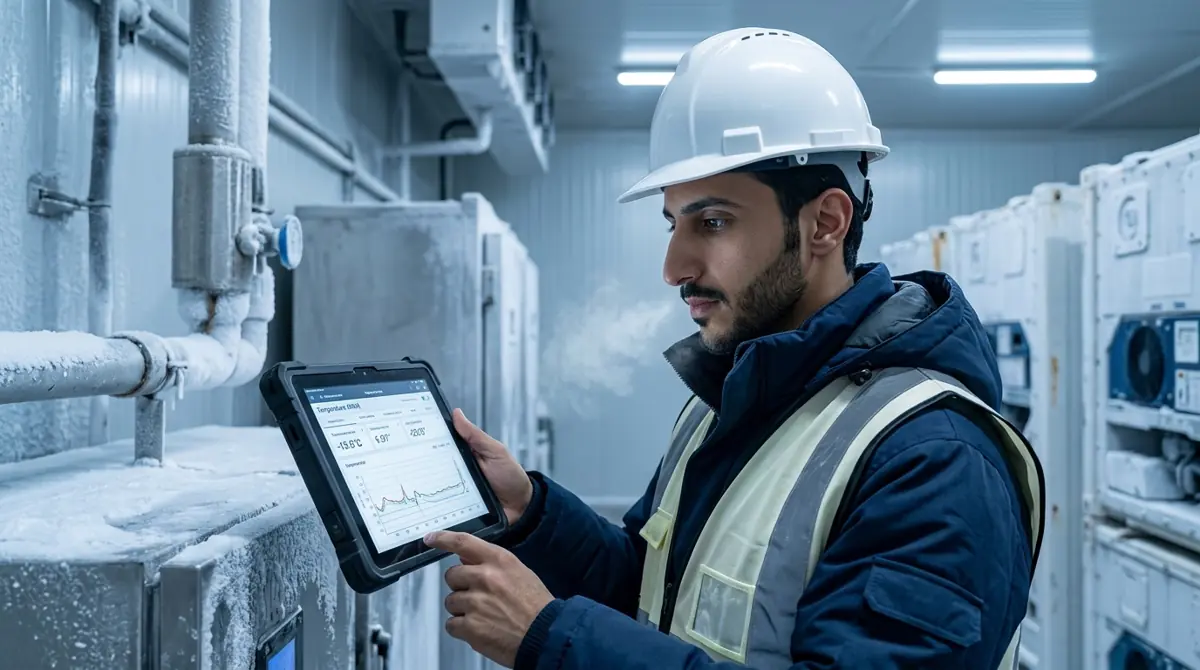

Why Cold Chain Is Harder in Saudi Arabia
A refrigerated truck leaves a Riyadh warehouse loaded with dairy and fresh meat for branches in Qassim and Hail. Inside the box it is 3°C. Outside, on a July afternoon, it is close to 47°C. At every drop the door opens and hot air rushes in. If the driver waits twenty minutes at a busy branch, or the reefer unit fails halfway, the load may arrive looking fine but no longer be safe.
That is the core problem of cold chain food distribution in Saudi Arabia: sensitive products, a harsh climate, long distances between cities, and clear regulatory responsibility on the distributor. The cold chain is not the cold room or the truck; it is every link between them: receiving from the supplier, storage, picking, loading, transport, delivery and returns. Break one link and everything downstream is compromised.
This guide covers the core SFDA requirements for transporting chilled and frozen food, the usual weak points at each stage, and how an ERP system helps control inventory, distribution, traceability and documentation, with hypothetical worked examples and an implementation plan.
What SFDA Requires for Food Transport
The Saudi Food and Drug Authority's "General Requirements for Food Transport" sets out rules that apply directly to cold chain distributors. The main points:
- Temperature ranges: chilled products are held between 1.5°C and 10°C depending on the product, with tighter limits by category. Chilled dairy and meat are capped at 5°C, fish and crustaceans at 0°C. Frozen food must be kept at -18°C or colder.
- Temperature recording: fridge and freezer readings must be recorded continuously and the records kept long enough to serve as a reference. The thermometer must be readable from outside the compartment and give a reading representative of the whole load space.
- Vehicle: dedicated to chilled or frozen food, well insulated, with enough cooling capacity to hold temperature for the whole journey, sealed against pests and dust, with smooth, corrosion-resistant, easy-to-clean interior surfaces.
- Loading: packages stacked on shelves or pallets, not touching the floor or walls, with gaps for air circulation. Air or plastic curtains at the doors are recommended to limit cold loss during loading and unloading.
- Pre-cooling: the refrigerated container should be set to 10°C or lower well before loading.
- Separation: different foods in one consignment must be separated, and unwashed raw vegetables kept away from ready-to-eat food.
In addition, the Implementing Regulations of the Food Law require factories, warehouses and distribution centres to have a food traceability guide, keep traceability records for at least 180 days (or longer if SFDA specifies), notify SFDA of suspected non-compliant food, and recall or withdraw it within the deadline SFDA sets. For warehouse-side requirements, see our article on SFDA food inventory compliance.
Temperature Limits by Category
The table summarises limits from the transport requirements for common categories. Always check the source document and the standard for your specific product, as some have stricter rules:
| Category | Maximum temperature in transport | Operational note |
|---|---|---|
| Chilled dairy | 5°C | Among the most affected by frequent door openings |
| Chilled meat | 5°C | Must be separated from ready-to-eat food |
| Fish and crustaceans | 0°C | Usually shipped with crushed ice |
| Frozen food | -18°C | Any rise should be logged and assessed immediately |
| Fresh table eggs | 11 to 15°C | Not "chilled" in the usual sense; overcooling harms them |
| Fruit and vegetables | Generally above 10°C | Some items suffer chill damage |
The practical point: one truck may not suit every category. Eggs and dairy in a single box set at 3°C harms the eggs; at 12°C it harms the dairy. That is a planning decision to make before loading, not at the dock.
Where the Chain Breaks, Stage by Stage
Receiving
The first weak point is the receiving dock. A delivery that waits an hour in the sun before inspection, or is accepted without a temperature check, means you have taken in product of unknown condition. Good practice: probe and record a sample on arrival, review the supplier's in-transit log where available, and reject or quarantine anything out of range before it enters stock.
Storage
A cold store needs temperature zones, each with its range and assigned items. Mixing items across zones because space is short in peak season is common, and the consequences show up later. First expired, first out (FEFO) should apply within each zone.
Picking and loading
Orders are often staged before dispatch. If the staging area is not chilled, or goods sit there too long, damage starts before the truck moves. Loading should follow delivery sequence: the last drop goes in deepest so the driver is not digging through pallets with the door open.
Transport
Reefer failure, switching the unit off to save fuel, a wrong setpoint, or loading warm product hoping it will cool on the road are all frequent causes. A truck reefer is built to hold temperature, not to pull down a warm load.
Delivery
The number and length of door openings is the biggest factor on multi-drop routes. One branch that takes half an hour to receive puts the entire load at risk, not just its own share.
Returns
Goods returned by a branch or customer have an unknown temperature history once they left you. Putting them back into saleable stock without assessment is one of the riskiest habits in the business.
How ERP Supports the Cold Chain
An ERP does not cool anything, but it controls and documents the decisions that protect the chain:
1. Item data as the foundation
Each item is defined with its temperature class, storage and transport range, shelf life and units of measure (carton, pallet, kilogram). Every later decision builds on this: where it is stored, what it travels with, when to warn about expiry.
2. Batch and expiry tracking
When each receipt is recorded with batch number and expiry date, picking can be directed to the earliest expiry first, and alerts can fire early enough to sell at a discount or move stock to a faster branch. In a recall, the system shows which customers received the batch, when and how much. Our guide to batch tracking goes into detail.
3. Warehouses and zones
Defining each temperature zone as its own storage location prevents frozen items being booked into a chilled zone and shows available capacity per zone ahead of peak season.
4. Delivery and route planning
Orders are grouped by area, temperature class and delivery window so the most sensitive items go first, door openings are minimised, and summer deliveries favour cooler hours. Load sequence follows delivery sequence.
5. Temperature records and integration
Data loggers in trucks and cold rooms are usually separate from the ERP, but linking their records to the delivery order or trip number gives every shipment its temperature history. When a complaint or inspection comes, the log, batches, customer and driver are in one place. This link is usually built through an API integration.
6. Controlled returns
Returns are received into a separate hold location and only move to saleable stock after a documented assessment. The return reason is recorded so you can see whether the problem lies with the item, the route or the customer.
7. Loss analysis
Every write-off is recorded with its cause: expiry, cold chain break, handling damage or unsaleable return. Over time patterns emerge: a particular route, truck, branch or supplier.
Worked Example: The Cost of Breaks
A hypothetical dairy distributor runs 30 reefer trucks with an average load value of SAR 45,000 per trip. Its records show 18 temperature incidents in a year that led to partial or full write-off:
| Item | Annual estimate |
|---|---|
| Product written off (average 40% of load × 18 incidents) | SAR 324,000 |
| Disposal and transport to disposal | SAR 18,000 |
| Urgent redelivery trips | SAR 27,000 |
| Team time on investigation and documentation | SAR 15,000 |
| Direct total | SAR 384,000 |
That excludes lost customer trust and regulatory exposure. If root-cause analysis shows 10 of the incidents happened on two long afternoon routes, moving them to early morning and splitting them could prevent more than half the loss. The numbers are illustrative; the lesson is that improvement starts with logging every incident and its cause.
What to Do When Temperature Goes Out of Range
A written procedure everyone knows matters more than how fast the alert arrives. A model procedure:
- Alert: when a truck or cold room logs an out-of-range reading, the driver or supervisor and the quality lead are notified at once.
- Immediate action: check the reefer and doors; move the load to a backup truck or the nearest cold store if it cannot be fixed.
- System hold: affected batches go to "on hold for assessment" so they cannot be sold or delivered until a decision is made.
- Assessment: the quality lead reviews duration, severity and product type, decides release or disposal, and documents the decision and reason.
- Customer notice if needed: if some quantity was delivered before the problem was found, the system identifies affected customers by batch and quantity.
- Root cause: the incident is logged with its cause (equipment, procedure or delay) for the monthly report.
Step four should follow criteria written in advance for each category, not judgement under pressure from a waiting customer.
Pre-Departure Checklist
- Reefer running, and box temperature at setpoint before loading.
- Data logger working and linked to the trip number.
- Box clean, sanitised and odour-free; door curtains intact.
- Load on pallets or shelves, clear of floor and walls, with airflow gaps.
- No thermally incompatible categories loaded together.
- Load order matches drop order.
- Driver has the drop list, delivery windows and branch contacts.
Turn the list into an electronic form the supervisor completes before releasing the trip, and it becomes part of the shipment record.
Cold Chain KPIs
| KPI | Calculation | Why it matters |
|---|---|---|
| Trips within range | Trips with no excursion ÷ total trips | Core measure of chain integrity |
| Temperature loss rate | Value written off for temperature ÷ chilled sales | Ties the problem to money |
| Expiry loss rate | Value expired ÷ average inventory value | Exposes weak FEFO or planning |
| Average unload time per drop | Total stop minutes ÷ number of drops | Identifies branches that put loads at risk |
| Supplier temperature rejection rate | Deliveries rejected for temperature ÷ deliveries received | Rates suppliers on cold chain discipline |
Ramadan, Hajj and Summer
Demand for chilled food rises in Ramadan and in Makkah and Madinah during Hajj and Umrah seasons, while summer brings peak heat stress. Planning starts months ahead:
- Review past seasons' sales by item and branch in the system to estimate volumes.
- Confirm enough cold storage capacity, or contract third-party cold stores in advance.
- Service truck reefers before summer, not during it.
- Shift delivery windows away from peak heat, and plan around the midday outdoor work ban (12:00 to 15:00 from 15 June to 15 September), which affects open-air loading and unloading.
- Train drivers and branch receiving staff on fast handover procedures before the season starts.
Home Delivery: An Extra Link
As online grocery grows, many distributors now deliver straight to homes, which is harder than branch delivery. Vehicles are smaller and often not fully refrigerated, drops multiply, and the customer may not be in. Practical answers include insulated bags or boxes with cooling packs per order, a maximum time from warehouse to doorstep, tight delivery zones, and a clear rule for failed deliveries: back to the cold store within a set time, not left in the van. See our article on last-mile delivery in Saudi Arabia.
A Four-Stage Implementation Plan
- Assessment: survey warehouses and trucks, list items and their temperature classes, and review current temperature and loss records to set a baseline.
- Master data: define items with temperature class and shelf life, set up warehouses and zones, and enable batch and expiry capture at receipt.
- Processes: FEFO picking, routes planned by temperature class, receiving and returns procedures, and logger records linked to trips.
- Monitoring: monthly loss reports by cause, reviews of the worst routes and suppliers, and procedure updates based on what you find.
How Tranquil Helps
Tranquil is a cloud ERP covering inventory (central inventory, multiple units of measure), sales (quotes, invoices, delivery, returns), purchasing, financial accounting and e-invoicing in one database. The Tranquil team can customise screens and reports and build API integrations with other systems, such as temperature loggers or vehicle tracking, to fit your operation. Explore our warehouse management solution or read about ERP for the food industry.
Frequently Asked Questions
What is the maximum temperature for frozen food in transport?
Under SFDA's General Requirements for Food Transport, frozen food must be kept at -18°C or colder, and chilled products between 1.5°C and 10°C depending on type, with tighter limits for categories such as dairy and meat.
How long must food traceability records be kept?
The Food Law Implementing Regulations require warehouses and distribution centres to keep traceability records for at least 180 days, or longer if SFDA specifies.
Is a truck data logger enough?
It is necessary but not sufficient. You also need its records linked to shipments, batches and customers, a clear procedure for excursions, and regular analysis of incidents and causes.
What is the difference between FIFO and FEFO?
FIFO ships the oldest receipt first; FEFO ships the earliest expiry first. In food, a newer batch can arrive with a shorter shelf life, so FEFO is usually the right rule.
Can chilled and frozen food travel in the same truck?
Yes, in multi-compartment trucks where each compartment has its own temperature control. A single box at one setpoint does not suit widely different ranges, and SFDA requires different foods in a consignment to be separated.
How do we get started with Tranquil?
Contact the Tranquil team to discuss your inventory and distribution processes and receive a quote within 24 hours.