
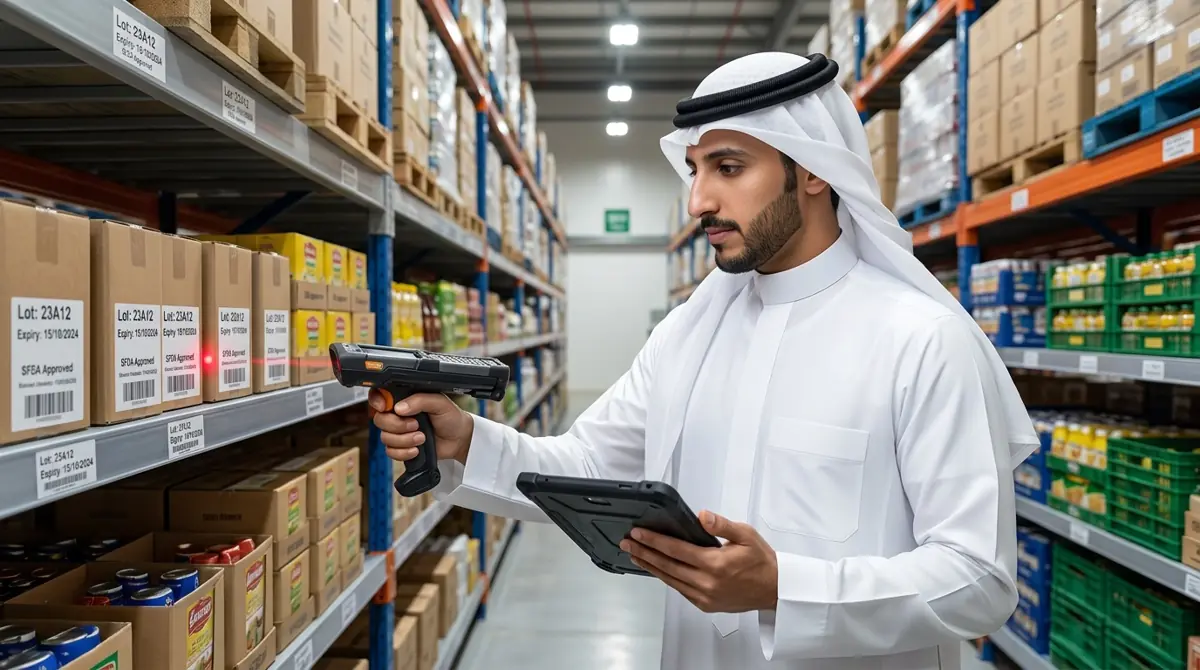

Why Food Inventory Is Different
A box of bolts in a building materials warehouse stays sellable for years. A carton of laban or a case of chilled chicken has days or weeks, a temperature it must not exceed, and a batch number you may need to trace within hours if the factory reports a problem. Managing food stock is therefore not just about quantities. It is about knowing which batch, with what remaining shelf life, stored and transported under what conditions, went to which customer.
In Saudi Arabia, food safety is overseen by the Saudi Food and Drug Authority (SFDA) under the Food Law issued by Royal Decree M/1 dated 29/10/2014 and its Implementing Regulations. This guide is written for food factories, their warehouses, distribution centers and distributors. It explains the requirements that touch inventory directly, turns them into daily procedures, and sets out what an ERP system needs to do to support them. It does not replace the current SFDA texts and the requirements specific to your activity.
Regulatory Requirements That Touch Inventory
Traceability and recall
The penalty table in the Food Law Implementing Regulations, in the section covering factories, warehouses and distribution centers, sets out clear obligations. The establishment must:
- Have a food traceability guide.
- Keep traceability records for at least 180 days, or longer if SFDA specifies.
- Notify SFDA when it suspects food is non-compliant.
- Recall or withdraw non-compliant food, and complete recalls within the deadline SFDA sets.
- Report on recalls.
In practice you must be able to answer two questions fast: where did this batch come from, and where did it go? This is usually called "one step back, one step forward": knowing the immediate supplier and the immediate customer for every batch.
Shelf life
SFDA governs food expiry dates through two standards: SFDA.FD 150-1 on mandatory expiration dates for food products and SFDA.FD/GSO 150-2 on voluntary expiration dates. Products covered by Part 1 have maximum shelf lives. Distributors need to know which of their items fall under which part, and check at receipt that remaining shelf life is acceptable.
Chilled and frozen transport
SFDA's General Requirements for Food Transport set temperatures: chilled containers between 1.5 and 10°C depending on product, with chilled dairy and meat at a maximum of 5°C and fish at 0°C, and frozen goods at -18°C or colder. They require continuous recording of refrigerator or freezer temperature with records kept for reference, a thermometer readable from outside, dedicated, insulated and clean vehicles, pallets that do not touch the floor or walls, air or plastic curtains at doors, and separation of food types.
A caution: not every "requirement" a supplier or competitor mentions is actually law. Check the SFDA source. Many articles in circulation quote unverified counts of "new requirements" and fine amounts.
From Requirement to Warehouse Procedure
| Requirement | Daily procedure | What the system must support |
|---|---|---|
| Traceability | Capture batch and expiry at every receipt; record the batch issued on every shipment | Mandatory batch and expiry fields at receipt and issue |
| Keep records 180+ days | Never purge stock movements early | Permanent, searchable transaction history |
| Recall | Identify customers and quantities for a batch within minutes | Batch-to-customer trace report |
| Shelf life | Reject receipts below agreed remaining life; pick earliest expiry first | Acceptance rule at receipt, batch suggestion at picking |
| Temperature | Continuous logging in cold rooms and vehicles; review excursions | Temperature records linked to location or shipment |
Receiving: The First Control Point
Most food inventory problems start at the dock, not on the shelf. A delivery accepted with short shelf life, at the wrong temperature or without batch details stays a problem until it leaves. A practical receiving checklist:
- Match the purchase order: item, quantity and unit of measure as ordered.
- Check temperature: probe chilled or frozen product when the vehicle door opens, and review the trip log where available.
- Check expiry: read the date and compare it with the minimum acceptable for that item.
- Record batches: one delivery can contain several batches; capture each with its expiry.
- Inspect packaging and labels: separate damaged cases and unclear labels.
- Store immediately: chilled product goes straight into the cold room, not onto the dock to wait.
- Document rejections: record the reason and notify the supplier.
When these steps live in the system's receiving screen, a storekeeper cannot complete a receipt without batch and expiry, and traceability becomes a by-product of normal work rather than extra effort.
First Expired, First Out
First in, first out is not enough for food. A new delivery can arrive with a shorter shelf life than stock already on hand, because it was produced earlier or sat at the supplier longer. The rule that matters is first expired, first out (FEFO).
Hypothetical example: a distributor holds three batches of a juice SKU.
| Batch | Received | Expires | Cartons |
|---|---|---|---|
| A | 1 March | 30 June | 200 |
| B | 10 March | 15 June | 300 |
| C | 20 March | 31 August | 400 |
FIFO ships A first, yet B expires two weeks earlier. If this SKU sells only 5 cartons a day, A takes 40 days, to roughly mid-April, and B then needs another 60 days, to around mid-June. B reaches its expiry before it sells through, and weeks earlier it is already being refused by customers with minimum remaining-life rules. FEFO ships B, then A, then C, and the write-off risk drops.
Minimum Remaining Shelf Life
Many large retail chains require suppliers to deliver with a minimum share of total shelf life remaining. These are commercial terms that vary by customer, not law, but they drive waste directly. If your biggest customer requires two-thirds of shelf life remaining, a product with a 90-day life must reach them with at least 60 days left, which gives you only 30 days from production for receipt, storage and delivery.
Set a minimum remaining life at delivery for each major customer and at receipt for each supplier. When a batch nears a key customer's limit, route it to other channels before it becomes unsellable.
Running a Recall Drill
Hypothetically, a cheese manufacturer tells a distributor that batch 2611 may be contaminated and must be withdrawn immediately. The distributor has three warehouses and 180 customers among groceries, restaurants and supermarkets.
- Stop issues: block the batch in every warehouse in the system so no more cartons leave.
- Size it: the batch was 1,200 cartons; 420 remain in stock.
- Find customers: the trace report shows 780 cartons shipped to 46 customers on specific invoices.
- Contact and collect: notify the 46 customers and schedule pickups in refrigerated vehicles.
- Notify SFDA in line with the requirements for non-compliant food and recalls.
- Settle: receive returns into a separate quarantine location, issue credit notes, and claim costs from the manufacturer.
- Report: quantities recovered versus shipped, the gap, and why.
If batches are recorded on every movement, steps 2 and 3 take minutes. If not, the distributor faces two bad choices: pull the SKU from every customer, or search loading sheets by hand. Run a mock recall on a real batch once or twice a year and time it.
Returns and Quarantine
Food distribution generates many returns: near-expiry stock sent back by customers, cases damaged in transit, recalled product. The risk is returns flowing straight back into available stock without inspection. Receive all returns into a quarantine location, in the system and physically, and let the quality lead decide each batch's fate: back to available stock if sound and never exposed to the wrong conditions, back to the supplier, or destroyed with a record. Chilled product returned with no evidence it was kept at the right temperature should not go back on sale.
Waste and Its Accounting
Near-expiry and damaged stock needs quick decisions: discount sale, another channel, return to supplier under the agreement, or documented destruction. Under IAS 2, inventory is measured at the lower of cost and net realizable value, so a batch that will only sell at a discount below cost must be written down. Destroyed quantities are removed with a destruction document stating batch, quantity and reason; keep destruction records with your inventory records so they are ready for audit.
The profit effect is easy to underestimate. A hypothetical distributor with SAR 30 million of sales at an 18% gross margin earns SAR 5.4 million gross profit. If expiry and damage cost 2% of its SAR 24.6 million cost of goods, that is SAR 492,000, about 9% of gross margin. Halving waste to 1% puts SAR 246,000 back into profit without selling one extra carton.
KPIs for Food Inventory
| KPI | Calculation | Why it matters |
|---|---|---|
| Waste rate | Value destroyed or expired ÷ cost of goods sold | Direct loss |
| Days of stock per SKU | Balance ÷ average daily sales | Compare with remaining shelf life to spot risk early |
| Receipt rejection rate | Rejected deliveries ÷ total deliveries | Reveals weak suppliers |
| Mock recall time | Time from alert to identifying all affected customers | Measures traceability readiness |
| Temperature excursions | Count and duration per room and vehicle | Flags equipment needing maintenance |
The comparison that matters most is days of stock against remaining shelf life. An SKU with 45 days of stock and 30 days of life left will partly spoil unless someone acts now.
Van Sales and Branch Distribution
Many Saudi food distributors sell through route salesmen with vans serving groceries and restaurants, or supply branches in several cities. Each van is a small moving warehouse and should be treated as one: the morning load is a transfer from warehouse to van by batch, every van invoice carries the batch issued, and end-of-day returns go to quarantine, not straight back to available stock. Without that, traceability ends at the warehouse door. Across branches, visibility of balances and expiry lets you move a near-expiry batch from a slow branch to a faster one instead of the second branch buying the same SKU while the first one writes it off.
Common Mistakes
- Optional batch numbers: captured sometimes, skipped other times, worthless at the first recall.
- Picking from the front: staff ship what is easiest to reach, not what expires first.
- Returns straight to stock: product exposed to the wrong temperature gets resold.
- Paper temperature logs: impossible to link to shipments or search when needed.
- Late expiry warnings: discovered when destruction is the only option left.
A Three-Phase Rollout
Phase 1: foundations
Decide which items need batch and expiry control and make those fields mandatory at receipt and issue. Write your internal traceability guide and name the quality lead who decides on returns and suspect batches.
Phase 2: rules
Configure FEFO picking, minimum remaining-life limits for suppliers and key customers, near-expiry alerts and quarantine locations.
Phase 3: test and improve
Run a timed mock recall, review waste KPIs monthly, and work on the largest causes of write-offs with purchasing and sales. Most waste traces back to over-ordering slow SKUs or to promotions planned without checking stock and shelf life.
What to Require From an ERP
When evaluating any system for food inventory, test these in a demo with your own data rather than accepting a feature list:
- Batch and expiry fields that can be made mandatory per item.
- FEFO batch suggestions at picking.
- Trace reports from batch to customers and from customer to batches.
- One-step blocking of a batch or location.
- Near-expiry alerts.
- Quarantine locations for returns and suspect stock.
- Multiple units of measure (piece, pack, carton, pallet) with correct conversions.
- E-invoicing compliant with ZATCA requirements.
In Tranquil, inventory management supports central inventory across warehouses and multiple units of measure and links to sales, returns, purchasing and accounting, and the system issues e-invoices compliant with Phase 1 and Phase 2. Screens, reports and approvals can be customized around your traceability procedures, so review your batch and expiry requirements with our team before rollout. For more, read our articles on batch tracking, cold chain management and ERP for the food industry.
Frequently Asked Questions
How long must food traceability records be kept?
At least 180 days under the penalty table in the Food Law Implementing Regulations, or longer if SFDA specifies. Accounting and tax records have their own, longer retention periods.
What is the difference between FIFO and FEFO?
FIFO ships the earliest received; FEFO ships the earliest expiring. For food, FEFO reduces waste because a newer delivery can have a shorter shelf life.
Which standards govern food shelf life in Saudi Arabia?
SFDA.FD 150-1 for mandatory expiration dates and SFDA.FD/GSO 150-2 for voluntary expiration dates.
What temperatures apply to food transport?
Under SFDA's transport requirements, chilled goods between 1.5 and 10°C depending on product, with a 5°C limit for chilled dairy and meat and 0°C for fish, and frozen goods at -18°C or colder, with continuous temperature recording.
Can Tranquil support a food distributor?
Yes, with multi-warehouse inventory, multiple units of measure, sales, returns and compliant e-invoicing, all customizable. Contact the Tranquil team to review your requirements.