

What Product Traceability Really Means
Picture an importer of electrical goods who receives a complaint about a faulty batch of chargers. The first questions are predictable: how many units from that batch did you sell, to whom, and where is the rest? If the answer takes a week, the importer will pull every charger off the market to be safe. If it takes an hour, only the affected units are withdrawn and the right customers are contacted directly.
That is the heart of traceability: knowing where any unit came from and where it went. It is often summed up as "one step back, one step forward". In manufacturing it extends to the raw material batches that went into each production run. In trading and distribution it runs from the supplier and shipment to the customer and invoice.
In Saudi Arabia, traceability connects to the conformity requirements that the Saudi Standards, Metrology and Quality Organization (SASO) runs through the SABER platform, and to Saudi Food and Drug Authority (SFDA) rules for food and medicines. This article sets out those requirements accurately, then shows how to build a working traceability system inside an ERP.
SABER and Conformity Certificates: The Basics
SABER was launched in 2019 under SASO's product safety programme and is now the electronic channel for conformity certificates for products covered by technical regulations. It works with two certificates:
| Certificate | Covers | Issued by | Validity |
|---|---|---|---|
| Product Certificate of Conformity (PCoC) | A specific product for a specific importer | An approved conformity assessment body, to a local Saudi entity | One year |
| Shipment Certificate of Conformity (SCoC) | A specific consignment | Issued only once valid PCoCs cover every product in the shipment | Per shipment |
There is also the Saudi Quality Mark, required for certain products such as plugs and switches. It is issued by a SASO-authorised body, is valid for three years, and manufacturers can obtain it voluntarily for products that do not require it.
One point that many articles exaggerate: whether you need a certificate, and which procedure applies, depends on the technical regulation covering the product, such as the regulations for car batteries, electrical appliances or toys. Any importer should start by identifying the technical regulation for each item it brings in, rather than assuming a generic list.
Why Certificates Alone Are Not Enough
A conformity certificate shows that a product complied when it entered the market. It does not answer what happens after: which batch arrived in which shipment, where it was stored, and who bought it. Those questions become critical in three situations:
- A complaint or incident: you need to identify the batch and supplier fast.
- A recall from the supplier or regulator: you need the list of customers who received the affected units.
- An inspection or audit: you need to show that every shipment came in with its certificate and every product was sold within its shelf life.
There is a commercial side too. Large retailers, government projects and main contractors increasingly ask suppliers to prove origin and conformity at delivery, sometimes with batch records per shipment. A supplier who can answer quickly earns trust; one who needs a week to compile the information loses points in every vendor review.
The Data a Traceability System Needs
Batch level or unit level?
- Batch (lot) tracking suits most consumer goods, building materials and food. Every quantity received or produced carries a batch number, recorded on every movement.
- Serial number tracking suits high-value devices, equipment and medical devices, where each unit and its warranty must be followed individually.
Standard identifiers
Traceability works best on identifiers that suppliers, warehouses and customers all understand. The GS1 Global Trade Item Number (GTIN) is the most widely used; in EAN-13 form it has 13 digits. Note that the prefix 628 belongs to GS1 Saudi Arabia, and GS1 prefixes identify the member organisation that issued the number, not the country of origin. A 628 barcode does not mean the product was made in the Kingdom.
Core fields for each movement
| Movement | Data required |
|---|---|
| Receipt from supplier | Item, batch or serial, production and expiry dates, shipment, conformity certificate reference |
| Storage and transfer | Location, batch, quantity, date, responsible person |
| Production | Raw material batches consumed, finished batch produced, quality check result |
| Sale and delivery | Customer, invoice, batch or serial, quantity |
| Return | Original invoice, batch, reason, disposition |
We cover the fundamentals of lot control in more detail in our article on batch tracking.
Linking SABER Certificates to Purchasing and Receiving
Certificates kept in a separate spreadsheet tend to end the same way: one expires and nobody notices until the shipment is at the port. It is better to hold each certificate as a record in the system, linked to the item and importer, with:
- PCoC number, issue date and expiry date.
- The technical regulation the item falls under.
- The conformity assessment body that issued it.
- Attached test reports.
Then add a few working rules:
- When a purchase order is raised for a regulated item, the system checks that the PCoC will still be valid on the expected shipping date and warns if it will not.
- An alert fires well before each certificate expires, say two months, because renewal takes time at the assessment body.
- At receipt, the SCoC reference is recorded against the shipment, so every batch in the warehouse traces back to its certificate.
These steps overlap with import, customs clearance and letters of credit, which we cover in LCs, imports and customs in ERP.
Food and Medicines: SFDA Requirements
For medicines, Saudi Arabia runs a national drug track-and-trace system based on a GS1 DataMatrix 2D barcode on packs. Phase 1, from February 2015, encoded the GTIN, batch number, expiry date and SFDA code; Phase 2, from March 2017, added a serial number. Saudi Arabia was the first GCC country with a national drug traceability system.
For food, the Implementing Regulations of the Food Law require factories, warehouses and distribution centres to have a food traceability guide, keep traceability records for at least 180 days (or longer if SFDA sets it), notify SFDA of food suspected of non-compliance, withdraw and recall it within SFDA's deadline, and report on the recall. Food also has specific storage and transport requirements, covered in our article on SFDA food inventory management.
Shelf Life and First-Expiry, First-Out
For products with a shelf life, knowing the batch is not enough; the earliest expiry has to leave first. The system makes that happen when it:
- Records the expiry date of every batch at receipt.
- Proposes the earliest-expiring batch on every pick or issue.
- Blocks expired batches, or those below a customer's minimum remaining shelf life.
- Flags batches nearing expiry early enough to discount them or move them to a faster-selling branch.
Large retail customers often require a minimum remaining shelf life on delivery. Recording that requirement on the customer record prevents sending a shipment that will be rejected at the dock.
A Recall Drill With Numbers (Hypothetical)
A building materials importer brings in tile adhesive from one supplier. The supplier warns that batch L-2417 may be defective. The shipment carrying that batch was 6,000 bags, spread across three warehouses.
Without traceability
The team knows roughly when the shipment arrived, but batch numbers were never recorded at receipt or dispatch. The only option is to recall every bag of that item sold in the three months after arrival, around 15,000 bags from several batches, and contact everyone who bought it.
With batch tracking
- A query on L-2417 shows 6,000 bags received: 1,150 in warehouse one, 800 in warehouse two, none in warehouse three.
- 4,050 bags were sold on 37 invoices to 22 customers.
- Stock on hand is put on hold immediately by changing its status to "blocked".
- The 22 customers are contacted with their invoice numbers and quantities.
The difference is scale as much as speed: 6,000 bags instead of 15,000, and 22 customers instead of the whole customer base. Recording the recall steps and outcomes in the system also provides the documentation a regulator will expect. Run a mock recall once or twice a year: pick a random batch and ask the team to locate every unit and customer. The time it takes is an honest measure of readiness.
Traceability in Manufacturing
In a factory, traceability has several levels. One finished batch may consume five raw material batches from three suppliers; one raw material batch may go into dozens of production runs. The system has to record, on every production order, the batches issued to it, the finished batch produced and the quality result.
Take a hypothetical household detergent plant in Dammam's industrial city that finds one batch of fragrance from a supplier is out of specification. Tracing back from that raw material batch shows it went into four production orders, yielding four finished batches totalling 18,000 bottles. 9,500 are still in stock and are blocked at once; 8,500 went to 14 distributors. Other production in the same period, made with a different fragrance batch, is unaffected and keeps selling. Without batch records on production orders, the plant would have had to stop everything produced in that period.
Barcodes and Scanning: The Practical Precondition
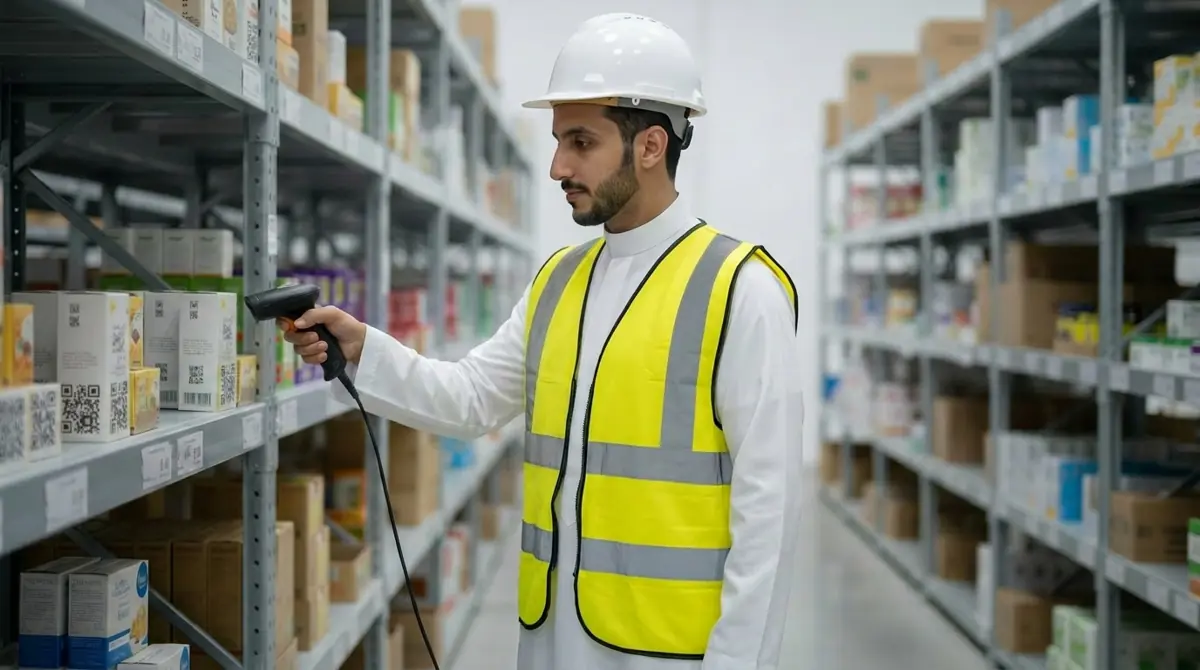
Traceability that depends on typing batch numbers by hand will fail. A picker preparing 80 orders a day will not key the batch accurately on every line. Each product, carton or pallet needs a barcode or 2D code carrying item, batch and expiry, and every movement needs to be recorded by scanning:
- At receipt: scan the supplier label, or print an internal label if the supplier's is insufficient.
- In storage: scan location and product together.
- In picking: the scan confirms the batch issued is the one proposed.
- In production: scan the raw material batches consumed on each order.
Tranquil supports barcode integration and quality checks in its manufacturing solutions, alongside inventory management with central inventory and multiple units of measure.
Reports You Should Be Able to Pull at Any Moment
| Report | Question it answers | Usually requested by |
|---|---|---|
| Forward trace of a batch | Where did every unit of this batch go? | Supplier or regulator during a recall |
| Backward trace of an invoice | Which batch and shipment did this customer's goods come from? | Customer making a complaint |
| Certificate status | Which regulated items are covered, and which certificates expire soon? | Purchasing and compliance |
| Remaining shelf life | Which batches expire in 30, 60 or 90 days? | Warehouse and sales |
| Recall log | Past recalls and recovery rates | Management and audit |
If any of these takes a day in Excel, start your improvements there. Responsibilities matter too: purchasing owns the certificate register, the warehouse owns batch accuracy, quality owns hold and release decisions, and sales owns customer contact during a recall.
Common Mistakes
- Batch captured at receipt only: you know what came in but not who it went to.
- Mixed batches in one location: two batches of the same item in one bin without separation make scanning pointless.
- One tracking level for everything: serialising cheap, fast-moving items burdens the warehouse for no benefit. Match the level to the risk.
- Certificates in email inboxes: they vanish when the employee leaves, and nobody is warned of expiry.
- Returns outside the system: returned goods go back on the shelf without batch or reason and mix with good stock.
A Five-Step Rollout
- Classify items: for each, is it under a technical regulation, and does it need batch, serial or no tracking?
- Build the certificate register: load valid PCoCs and expiry dates, linked to items and suppliers.
- Labels and devices: agree label formats with suppliers or set up internal label printing, and equip warehouses with scanners.
- Movement rules: make batch mandatory on receipt and issue for tracked items, and switch on first-expiry, first-out.
- Drill and review: run a mock recall a month after go-live and close the gaps it reveals.
If you would like a review of your warehouses' traceability readiness, contact the Tranquil team.
Frequently Asked Questions
Does every imported product need a SABER certificate?
No. It depends on the technical regulation covering the product. Identify the regulation for each item before importing and check its requirements on SABER or with an approved conformity assessment body.
What is the difference between a PCoC and an SCoC?
A PCoC covers a specific product for a specific importer and is valid for one year. An SCoC covers a single shipment and is issued only once valid PCoCs exist for every product in it.
Is batch tracking enough, or do I need serial numbers?
Batch tracking is enough for most goods. Serial numbers justify their cost for high-value devices and products with individual warranties or unit-level regulatory requirements, such as medicines.
How long must food traceability records be kept?
The Food Law Implementing Regulations require at least 180 days, or longer if SFDA specifies. A system can keep them far longer at negligible extra cost.
Does a 628 barcode prefix mean a product is Saudi-made?
No. It means the number was issued through GS1 Saudi Arabia. GS1 prefixes show the issuing member organisation, not where the product was made; origin comes from shipping documents and the certificate of origin.
How can I tell whether we are ready for a recall?
Run a mock recall on a random batch. If the team can locate remaining stock and every customer who received it within a few hours, the system works. If it takes days, batch capture has a gap somewhere.