

Why Imports Need More Control Than Local Purchases
A local purchase is simple: a purchase order, a delivery, an invoice, a payment. An import through a Saudi port involves a supplier abroad, a bank on each side, a shipping line, a freight forwarder, a customs broker, ZATCA customs through the Fasah platform, and often SASO's SABER platform or the SFDA. Documents travel separately from goods, money moves on different dates from the goods, and the real cost of the shipment is not known until weeks after the supplier's invoice arrives.
When this is managed by email and spreadsheets, three problems repeat. Letters of credit hit discrepancies because a document did not match the credit terms. Containers wait at the port because a certificate was missing or a declaration was wrong. And products are priced on the supplier's price plus a rough percentage, so some items sell below their true landed cost without anyone noticing.
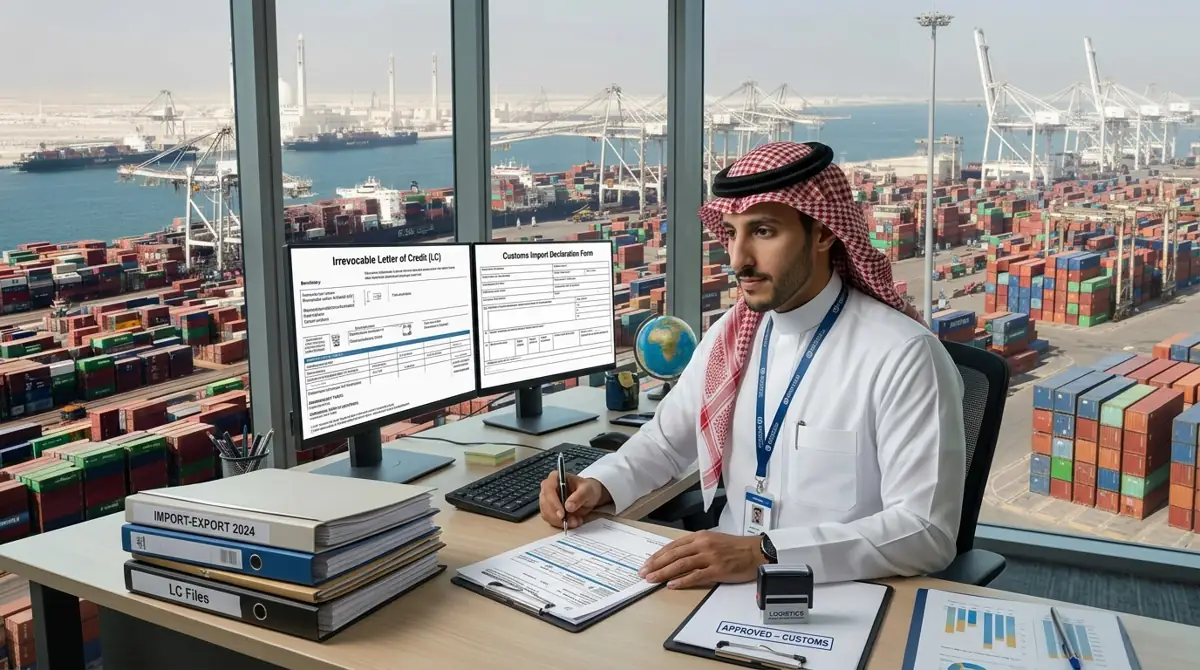
Letter of credit and import management via Saudi ports means bringing the whole cycle into one record per shipment: the purchase order, the payment instrument, the shipping and clearance documents, the conformity certificates, every cost added on the way and the final receipt into stock. This guide explains each part and how an ERP holds it together.
The Import Cycle Step by Step
- Purchase order: item, quantity, price, currency, Incoterm and payment method agreed with the supplier.
- Payment instrument: letter of credit opened, documentary collection agreed, or advance transfer made.
- Conformity: for regulated products, product certificates obtained in SABER before shipment, and a shipment certificate issued for the consignment.
- Shipment: supplier ships and sends documents: commercial invoice, packing list, bill of lading, certificate of origin and any health or conformity certificates.
- Bank and documents: under an LC, documents are presented to the bank, examined and, if compliant, paid or accepted.
- Customs: the customs declaration is filed through Fasah, duties and import VAT are paid, the shipment may be inspected, then released.
- Delivery and receipt: goods move from port to warehouse, are inspected and received into stock.
- Cost closing: freight, insurance, duties, clearance, transport, certificate and bank charges are allocated to the items to set their landed cost.
Choosing the Payment Method
| Method | How it works | Risk for the importer | Cost and effort |
|---|---|---|---|
| Advance transfer (T/T) | Pay before shipment | Highest: you rely on the supplier to ship | Low bank cost, cash tied up early |
| Letter of credit | Your bank undertakes to pay against compliant documents | Low on payment, but documents are checked, not goods | Opening, amendment and other fees; heavy paperwork |
| Documentary collection (D/P or D/A) | Banks exchange documents for payment or acceptance of a draft | Moderate: no bank undertaking to pay | Lower fees than an LC |
| Open account | Pay after delivery on agreed terms | Lowest for the importer | Usually only with trusted, long-term suppliers |
Many importers use a mix: LCs for new suppliers and large orders, collections or open account for established relationships. The ERP should record the method on each purchase order so finance can see future commitments by type.
Managing Letters of Credit
Most documentary credits worldwide are issued subject to the ICC's Uniform Customs and Practice for Documentary Credits, UCP 600, which took effect on 1 July 2007. Two principles matter for day-to-day control. Banks deal with documents, not goods: if the documents comply with the credit, the bank pays, even if the goods turn out to be wrong. And each bank has a maximum of five banking days after the day of presentation to decide whether the documents comply.
What to record for each LC
- LC number, issuing and advising banks, amount, currency and tolerance.
- Latest shipment date, expiry date and place of expiry.
- Required documents and their exact wording, partial shipment and transshipment terms.
- Linked purchase order and supplier, margin or facility used, and all bank charges.
- Status: requested, issued, amended, documents presented, paid or accepted, closed.
Where discrepancies usually come from
The typical causes are practical, not exotic: shipment after the latest date, presentation after expiry, goods descriptions on the invoice that differ from the credit, missing or unsigned documents, inconsistent quantities or weights between documents, and amounts above the credit value. Most can be prevented if the LC terms are stored with the purchase order and checked against the supplier's draft documents before shipment. An ERP alert on approaching shipment and expiry dates prevents the most common one of all: simply running out of time.
Customs Clearance Through Fasah
Fasah is ZATCA's electronic platform for import and export trade services. It connects the public and private parties involved in clearance and offers services such as clearance, truck appointment booking, shipment tracking and electronic payment through Fasah Pay. Users include importers, customs brokers and freight forwarders, and registration requires the company's commercial registration.
The ERP does not replace Fasah or your broker, but it should hold everything the declaration needs and record what comes back:
- Tariff code for each item, maintained in the item master. GCC states moved to a 12-digit tariff from January 2025, so check that codes in the system are current.
- Country of origin, customs value and quantities per item, consistent with the commercial invoice.
- Declaration number, duties and VAT paid, inspection result and release date for each shipment.
- Scanned documents linked to the shipment record for audit and future enquiries.
Duties and import VAT
Saudi Arabia applies the GCC common external tariff, generally 5% on most goods from outside the GCC, charged on the CIF value, with some items exempt and some at higher rates. Goods originating within the GCC are generally exempt from duty. Import VAT at 15% is charged on the customs value plus duties and other fees. It is deductible as input VAT by the importer of record when the goods are used for taxable supplies. Frequent importers may apply to account for import VAT through their VAT return instead of paying it at customs, subject to approval and a clean compliance record.
SABER and Other Product Requirements
Products covered by a SASO technical regulation need a product certificate of conformity (PCoC) issued through SABER by an approved conformity assessment body. A PCoC is issued only to a local Saudi entity, per importer per product, and is valid for one year. A shipment certificate (SCoC) is then issued for each consignment, but only after valid PCoCs cover every product in it. Some products also need the Saudi Quality Mark. Food, medicines and cosmetics fall under SFDA requirements instead.
In the ERP, store the PCoC number and expiry date against each item and supplier, and block or warn on purchase orders for regulated items without a valid certificate. That one control prevents a container from arriving at Jeddah Islamic Port or King Abdulaziz Port in Dammam without the paperwork it needs. Our article on traceability and SABER covers the conformity side in more depth.
Landed Cost: The Number That Protects Your Margin
Landed cost is everything it takes to get the goods into your warehouse in saleable condition. IAS 2 includes in the cost of inventory the purchase price, import duties and other non-recoverable taxes, transport, handling and other costs directly attributable to acquisition. Recoverable VAT is not part of cost.
Worked example
A hypothetical importer buys two items from a supplier outside the GCC, shipped on CIF terms. The supplier invoice is USD 42,667, or SAR 160,000 at the fixed rate of SAR 3.75 per dollar, split SAR 100,000 for item A and SAR 60,000 for item B.
| Cost element | Amount (SAR) | Treatment |
|---|---|---|
| Supplier invoice (CIF) | 160,000 | Inventory cost |
| Customs duty at 5% of CIF | 8,000 | Inventory cost |
| Import VAT at 15% of (CIF + duty) | 25,200 | Recoverable input VAT, not cost |
| Clearance, port and handling charges | 3,500 | Inventory cost |
| Transport from port to warehouse | 2,000 | Inventory cost |
| Conformity certificate fees | 1,500 | Inventory cost |
| LC charges | 1,200 | Inventory cost, per company policy |
| Landed cost excluding VAT | 176,200 |
Allocated by value, item A carries 62.5% of the additional SAR 16,200 (SAR 10,125) and item B carries 37.5% (SAR 6,075). Landed cost is SAR 110,125 for A and SAR 66,075 for B, about 10% above the supplier price. If the sales team prices on the supplier price plus a margin, that 10% comes straight out of profit. Allocation by weight or volume may be more accurate for freight when items differ greatly in size; the ERP should allow the basis to be chosen per cost type.
Costs that arrive late
The clearance agent's invoice or a demurrage charge often arrives after the goods are already in stock and partly sold. The ERP should let you add these to the original shipment, adjust the cost of what is still in stock and send the share relating to goods already sold to cost of sales. Demurrage caused by your own delay is usually better treated as an expense than as inventory cost, since it is not a normal cost of acquisition.
Currency Risk
The riyal has been pegged at SAR 3.75 per US dollar since 1986, so dollar-denominated imports carry little exchange rate risk. Purchases in euros, yuan, yen or lira do. Under IAS 21, a foreign currency purchase is recorded at the spot rate on the transaction date, and any difference when the payable is settled, or retranslated at period end, goes to profit or loss, not to inventory cost.
Example: goods invoiced at EUR 50,000 are received when the rate is 4.10, so inventory and payable are recorded at SAR 205,000. Payment is made when the rate is 4.18, costing SAR 209,000. The SAR 4,000 difference is an exchange loss in the income statement. An ERP should record the rate at each step, calculate realised and unrealised differences automatically and report open payables by currency so treasury can decide whether to hedge.
Goods in Transit and Incoterms
The Incoterm on the purchase order decides more than who pays freight. It also signals when risk passes from seller to buyer, which in turn affects when you should recognise the goods as your inventory. Under FOB, risk passes once goods are loaded on board at the port of shipment, so a container on the water may already be your stock. Under DAP or DDP, the supplier carries the goods to your named place.
For month-end, this means an importer can have significant inventory that is neither in the warehouse nor in the supplier's hands. Without a goods-in-transit account, either the stock is missing from the balance sheet or the payable is recorded without the asset. An ERP that records the shipment with its Incoterm, shipping date and bill of lading can post goods in transit and move them into warehouse stock on receipt.
Month-End Controls for Importers
- Reconcile LC margin and facility balances with bank statements.
- Review open shipments: goods in transit, expected arrival and cost invoices still to come.
- Accrue known costs that have not yet been invoiced, such as clearance and transport.
- Reconcile import VAT on customs declarations with input VAT claimed in the return.
- Retranslate open foreign currency payables at the closing rate.
The Shipment as the Central Record
Bringing everything together around one shipment record is what makes imports manageable:
| Linked to the shipment | Why |
|---|---|
| Purchase orders and supplier | What was ordered, at what price and terms |
| LC or collection | Payment status, deadlines and bank charges |
| Documents | Invoice, packing list, bill of lading, origin and conformity certificates |
| Customs declaration | Duties, VAT, inspection and release |
| Cost invoices | Freight, clearance, transport, fees |
| Goods receipt | Quantities received, shortages, damage |
From this record you can also measure actual lead time per supplier and route, from order to receipt, which improves reorder planning. Our guide to lead time management explains how to use those figures.
How Tranquil Supports Importers
Tranquil is a cloud ERP with purchasing, inventory with multiple units of measure, financial accounting and ZATCA e-invoicing in one system, and solutions for trading companies. Its customisation services cover screens, reports, multi-level approvals and API integrations, which importers often use to fit their shipment and document workflow.
Frequently Asked Questions
Is a letter of credit always the safest option?
It protects payment but not quality, because banks check documents rather than goods. With a reliable supplier, a documentary collection or open account may be cheaper with acceptable risk.
Is import VAT part of inventory cost?
No, if you are VAT registered and the goods are used for taxable supplies. It is recoverable input VAT. Customs duty, however, is part of cost.
What is the general customs duty rate in Saudi Arabia?
Most goods from outside the GCC carry the common external tariff of 5% of CIF value, with some exemptions and some higher rates. Check the tariff for each code.
When do I need a SABER certificate?
When the product is covered by a SASO technical regulation. You then need a product certificate per product and a shipment certificate for each consignment.
How should late cost invoices be handled?
Add them to the shipment, adjust the cost of stock still on hand and charge the share for goods already sold to cost of sales. Contact the Tranquil team to review your import process.